Talking with Nu Jazz
An Interview by Clara Joy
April 13th, 2022, NYC
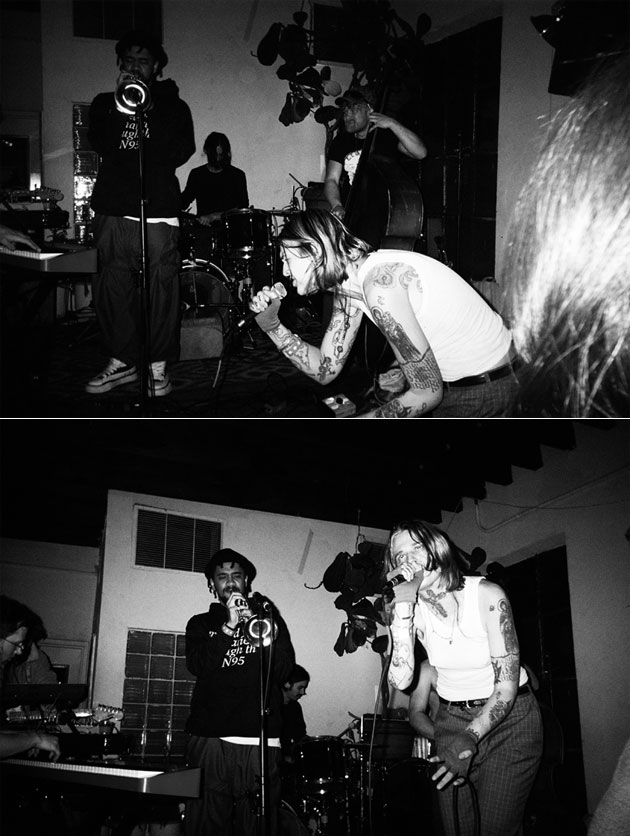
Left: Ryan Easter, trumpet, right: Danny Orlowski, singing, with Nu Jazz at Trans Pecos, Brooklyn NYC, March 4, 2022
by Clara Joy
When did you start Nu Jazz and how did it come about?
Danny: I guess technically Ray and I came up with “nu jazz” when we were releasing I Don’t Know How To Be Happy, and they asked us what genre to label it for digital distribution. We said “nu jazz,” and everyone laughed because they thought we were joking. But Deli Girls has always been about improvisation and musical conversation, and I’ve always felt our presence has a strong jazz ethos. Ray and I finally decided to reach out last year in March, which was when we started jamming with John, Kevin, and Ben. We had the privilege of playing our first show with Jaimie Branch appearing on trumpet. Ryan officially joined nu jazz in the fall and it’s really completed the band and brought the sound to a new level. I think all the time how fortunate I am to work with such insanely talented musicians. They’re all first choice, period.
Ray: Nu Jazz began last year in the 5950 Studios as an experiment. Danny and I had long joked that our genre of music (as deli girls and other projects) should be referred to as “New Jazz” (a sobriquet that inspired many a groan and nervous glance from our friends at Sweat Equity) because of our emphasis on live improvisation and smashing together seemingly contradictory influences and sounds to create our music. Over the years the joke and mentality behind it stuck around; and after the string of disappointments, cancellations, financial and creative pitfalls that was Covid and lockdown, we started taking the idea more seriously and began thinking of who and how to make Jazz music in the 21st century.
Ben: I ran into Ray for the first time pretty serendipitously on the patio outside of my recording studio in Ridgewood called 5950.exp. They were wearing sick shades and dissed my pizza taste and I immediately respected their honesty despite feeling slightly threatened. I was familiar with Deli Girls’ music at the time and we started chatting about our own music processes and specifically engineering and mixing. I had made a crazy track the day before and played it for them. It’s something musicians do to gain the respect of one another. I think Ray was kind of impressed, which was sort of my intention, because you can tell on another musician’s face when they fuck with something you made. Ray mentioned to me that they and Danny were thinking about starting a jazz trio with 5 musicians including John Bemis of Murderpact and Kevin Eichenberger of The Beak Trio and CGI Jesus, which I thought was hilarious but kinda brilliant. We got into a bit of a jam session afterwards and everything sort of naturally progressed from there. John and Kevin joined shortly thereafter to solidify the idea, and Ryan a bit later. We’ve been playing and recording at 5950 ever since. The group didn’t have a name at the time but we were just having fun. Working together as a band has never felt forced in any way.
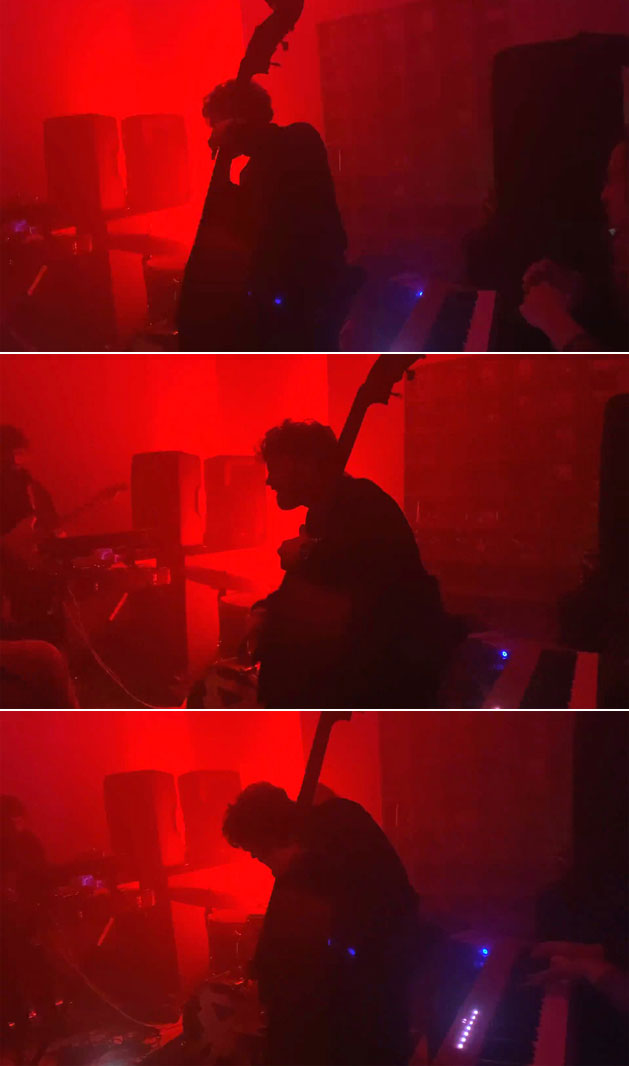
Kevin Eichenberger, acoustic bass, performing with Nu Jazz at IRL NYC, Brooklyn, NYC, January 20, 2022
How do you relate to Nu Jazz, Danny and Ray, coming from the experience of being the singer and producer of Deli Girls? is there a strong relationship between these two projects for you both?
Danny: nu jazz and deli girls are definitely related, but nu jazz is more of a full jump into jazz, a convergence of musicians bigger then just our project. For me, nu jazz is a challenge, especially since I’m the only non-classically trained musician in the group. But that’s exactly why I love it. Anything can change on a dime, unlike the limitations of electronic music. It requires a deep, listening presence, listening to 5 other people’s moves at all times. I’ve been learning so much. I’ve always wanted to work more with Ray’s piano playing as well, so this is where I’ve been able to relate to it. Ideally, I always want to be making new kinds of music. It’s really cool to bring all of these individuals together and collectively elevate each other in a new lane. It’s been so refreshing meeting some of the experimental jazz community, and I really love how much they’re there for the music, no pageantry.
Ray: There is a strong relationship between the projects. Number one, all of our collaborators come from other (mostly non-Jazz) bands that bring a strong Jazz ethos to their music making in the same ways that I think Danny and I bring it to the deli girls project. Two, as a musician and producer I am always looking for how to carve my own angle on a situation–be it the tools or techniques I use (or don’t) the level of improvisation built into a song etc. I knew coming into Nu Jazz as a player, I distinctly wanted to drive music and conduct from the piano the same way I would from a drum machine or sequencer. In deli girls I try to play a drumkit like a piano, and in nu jazz I try to play the piano like a sampler.
Danny, you recently told me that you’re the only non-trained musician in the group, how do feel being the lead singer in relationship to that?
Danny: honestly, if it weren’t for the fact that everyone in the band is such a real one, maybe I would be more nervous. There are definitely times I doubt myself but everyone is very encouraging. Even if I don’t understand complex music theory, years of experience does get you somewhere, and I’m never afraid to ask questions. I guess the vocalist is kind of a good place in a band for no classical training, all drama. I am aware that I bring something to the band that none of the other members have, and the same is true for everyone else of course. A lot of times I am in shock that I get to work with some of the best out there at their instrument….but I have to humbly conclude that I belong too, haha.
Kevin: I personally feel that Dan has a very unique skill set when it comes to vocals… and I have a music degree! There’s an idea that scream/growling vocals are always going to come across as super droney, monotonous, and usually unintelligible. This really isn’t the case with Danny’s vocals. I’ve found that there are many dynamics and tonal shifts that someone who isn’t a super innate and experienced musician would ever execute, trained or not. As someone who’s played with dozens upon dozens of super trained musicians, I find that they’re really much easier to follow musically than almost any of them.
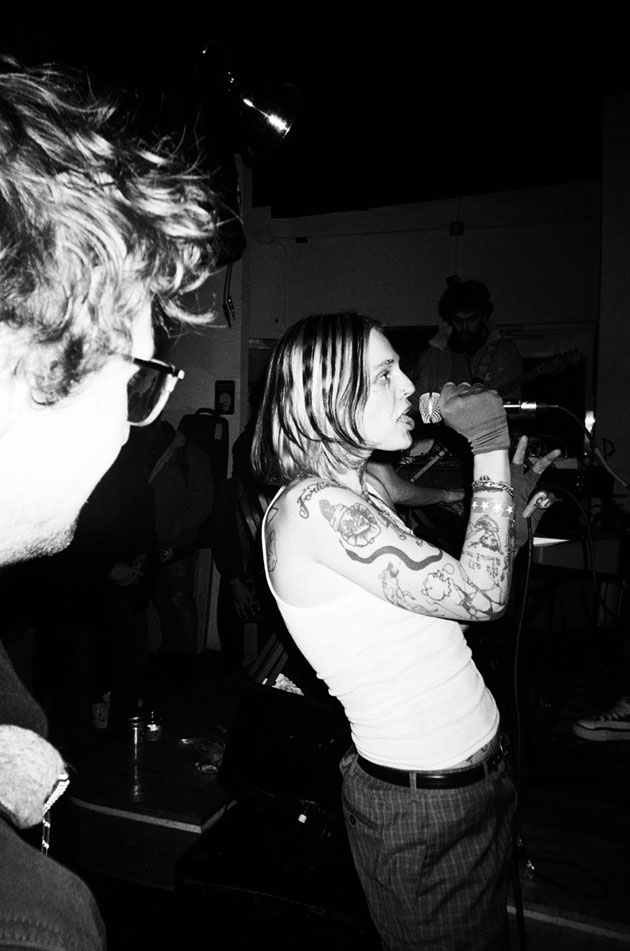
Danny Orlowski singing with Nu Jazz at Trans Pecos, Brooklyn, NYC, March 4, 2022
Who are some of the inspirations for Nu Jazz for you all?
Danny: I have a specific idea of what I want “jazzcore” to sound like, and I haven’t found anything that is 100% it yet, so I want to make it. But some that have good elements are: John Zorn, 16-17, Mr. Bungle, ephal duath, painkiller, Zu, starfuckers, psychofagist… the hardcore part of my influence is definitely early 2000s hardcore.
Ray: This will come as a surprise to exactly no one who knows me, but one of my biggest influences in Nu Jazz and life is the legendary Japanese musician Ryuichi Sakamoto whose work has guided me through almost every endeavor. There are certainly other influences, but Sakamoto’s is the greatest felt; due to the fearless piano/composer FIRST attitude he brings to all of his work. This is a man who has incorporated every genre imaginable, including ones he arguably invented, into his craft. Who has consistently innovated as a composer, a player, a collaborator, and an artist. Sakamoto brings a certain sophistication to everything he does, and as a pianist is one of the most innovative and influential players to this day. However, he has consistently been able to maintain a distinct Pop sensibility to his music, allowing his work to be accessible to both musical elites and “normal” people (I despise the concept that anyone should need to explain why a work of art is good.) I think it’s his constant reminder of Pop’s unique power to influence and bypass all of the normal barriers of experimental music that has made Sakamoto such a tremendous influence on my work and life.
Kevin: I deeply love and am inspired by the great jazz of the 20th century and today. Some of my biggest and earliest influences that have stuck with me throughout the years are Charles Mingus, Duke Elligton, Ornette Coleman, Miles Davis’s various bands, Roy Haynes, Andrew Hill, Charlie Haden, Billie Holiday, Dave Holland, Trane, Monk, Bird, Hermeto Pascoal, Keith Jarrett’s American Quartet and Quintet etc… Too many to name! In my mind these are the greatest artists of modern times and truly have defined most american culture that’s come since, maybe even regardless of medium. They just simply made the best damn music, period. I spent a lot of my adolescence going to punk and metal shows, which was popular in central and western Virginia, the area I grew up in. My mom actually introduced me to bands like The Minutemen, Black Flag, and Fugazi when I was only about 12 or 13. The intensity, aesthetic, and rhythmic qualities of that music has very much had an impact on the way I play and has become even more evident to me as I’ve gotten older. I’ve also been pretty influenced by the simple melodicism and emotional rawness of country artists like Kris Kristofferson, Willie Nelson, Lefty Frizzell, even George Strait! Hip Hop and Trap artists like Gucci Mane, Lil Boosie, and Waka Flocka all appealed to me a whole lot in my formative years for similar reasons as punk and metal. My father is also someone that raised me on very, very deep music. I mean stuff like War, Ali Farka Toure, Sly & The Family Stone, obscure jazz like Don Pullen & George Adams, even Primus, one of my all time favorites! I find that oftentimes I care less about genre and more about the music having a strong and well executed aesthetic going on, as well musical qualities like super rich rhythm and a warm bodied sound with a certain metallic toothiness to it. Hence why I love jazz, heavy music, og fusion, and trap music so much…. they all share these qualities.
Ryan: Having recently being welcomed into the group, there are a few sources that I feel that I can pinpoint, as well as channel for my own contributions. Listening to Nu Jazz, I hear a decisive sync between the worlds of heavily-improvised black musics (such as the likes of Ornette Coleman, The Art Ensemble of Chicago, Albert Ayler), psychedelic rock/funk (Pink Floyd, The Hendrix Experience, The Sound of Animals Fighting), and somewhat of a light sprinkling of Gigi Allin (respectfully). Beyond the musical influences, the atmosphere ping-pongs between subtle intimacy and acute rage, so I’d dare say that the 21st century and its unfolding may be the strongest inspiration.
Ben: Jazz artists like The Art Ensemble of Chicago, Miles Davis, Chick Corea, Cecil Taylor and Sun Ra first come to mind. As the sort of the lead electronics technician in the group, I’ve had to sort of invent my own instrument to perform with the band, and I’m personally influenced by a lot of more experimental electronic and ambient music like that of Alessandro Cortini of Nine Inch Nails, Lucretia Dalt, Daniel Lopatin, Debit, Jon Hassel, Andy Stott, Tim Hecker, Nic Endo, CS + Kreme, anything with a kind of dark, emotional, and a bit cold and dreary undertone. We’re also sort of seeing the resurgence of trip hop and downtempo in our sound but in a less structured and more improvisational way, specifically looking to artists like Amon Tobin, Massive Attack, Thievery Corporation, Tricky, and Hysterical Love Project.
John: For the most part it’s been groups and artists with a distinct vocabulary, cross-section of influences or lineup; Bill Dixon, James Newton, Jon Hassel concert group, Nihiloxica, Miles‘ electric band, Codona, Modern Jazz Quartet, OOIOO, Sun City Girls, Tortoise, Maurice Louca, Jemeel Moondoc Sextet have all been back in heavy rotation for me since Nu Jazz began. Jazz, experimental and heavy music with that width of palette is huge for my understanding of the project; Art Ensemble, Mr. Bungle, Fantomas, Boredoms, Ulver, Melt Banana, etc. But mostly I’m inspired by the idea of synthesizing/adapting the sounds present in our ensemble; Ryan, Danny, Ray, Kevin and Ben are incredibly flexible, original and tasteful musicians; rising to that occasion keeps me hype, and I love when it feels like we’re taking risks and honing a distinct language between strong personalities.
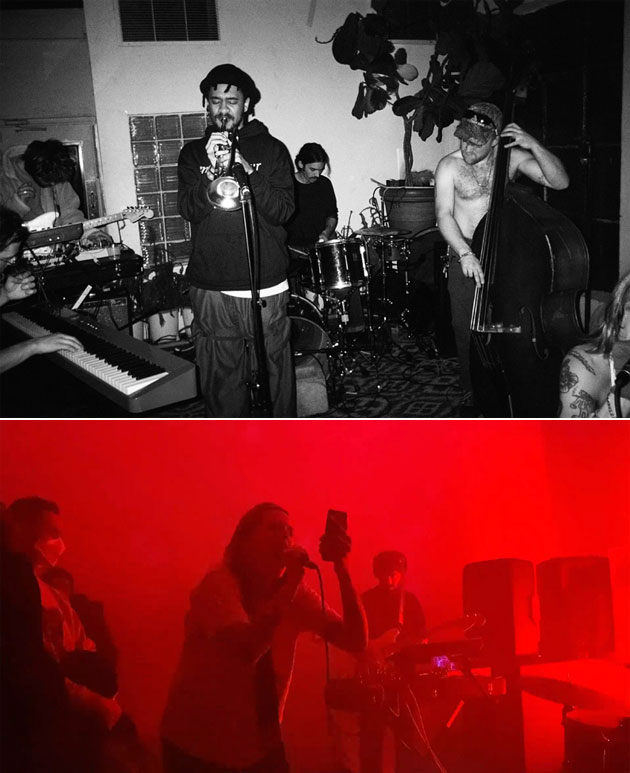
Above: Ryan Easter trumpet, below: Danny Orlowski singing, with Nu Jazz, Brooklyn, NYC
How do you relate to the name of your group “Nu Jazz”, as a concept for the art you are all making?
Danny: the name “nu jazz” is really a bit of a joke gone too far, but it’s also somewhat accurate. We love jazz, but I think we like to make fun of jazz too…(how can you not?) I feel like I can cover different lyrical ground in nu jazz; the music sets the tone for deeper, sometimes more conceptual themes.
Ray: Jazz is sort of an intimidating word isn’t it? This is the history of music in America, with all its warts, encapsulated in a single word. I think this is deserved but has built some tremendous barriers that can make contemporary musicians hesitant to innovate (or bastardize) the genre or feel like they don’t get to have a say. Nu Jazz is a perfect way to describe our music, which I feel echoes the history and ethos of Jazz without merely being an emulation or repetition of the giants upon whose shoulders we stand. It’s also a little cheeky and not serious–and may piss some people off–which I think also fits quite well in this genre’s history. Did you really expect the band “deli girls” to spend too much time agonizing over a name?
Ryan: While the name itself reflects the textbook definition of the sub-genre, the group and its creations speak more to a growing expansion of the approach towards improvised music. While the influences, however various and vast, can be heard, the incorporation of spoken word and the subject matter, the role of Besh’s electronics and Danny’s voice manipulation, the yet-traditional instrumentation, all create an atmosphere of newness.
Ben: I think everyone in the band is a pretty forward thinking musician, and we are all into music on the fringes, sounds that often slip through the cracks. When we are jamming together, we’ve never once, to my memory, decided what we should do or play. There is some sort of collective consciousness, a shared but unspoken ideology between us all that kind of guides our sound without words. Coming from different backgrounds and musical styles, we are kind of united under the idea that we want to make music that sounds new, but we don’t have to try and do it, or even think or talk about it. It’s really the natural product of our differing perspectives and tastes that creates our uniqueness. The name embodies this idea; jazz isn’t always a specific sound although it tends to be defined as such, it’s really a mindset, a process, and a way of viewing the world.
John: I have a genuine soft spot for the genre briefly known as “Nu Jazz“; Amon Tobin, Xploding Plastix, Nils Petter Molvær, Flying Lotus, a lot of that shit is sick and honestly overlooked; that idea of transposing a craft onto different styles is a serious point of inspiration. “Nu Metal” holds a similar place in my heart; growing up seeing bands like Slipknot, KoRn and SOAD piss off the supposedly-rebellious metal establishment taught me everything. And like Ray mentioned, I think there’s a current through jazz, metal/hardcore, electronic music, experimental/noise shit that is intentional and thoughftul while also totally ballistic and irreverant, and I think we’re adding to it.
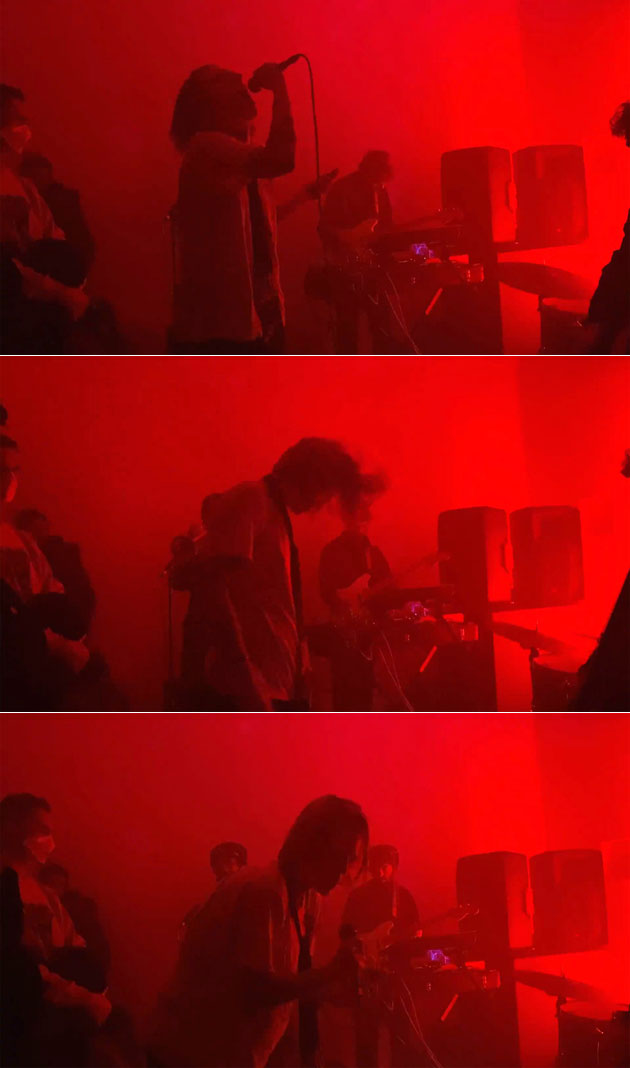
Danny Orlowski performing with members of Nu Jazz at IRL NYC, Brooklyn, NYC, January 20, 2022
Is a Nu Jazz performance rehearsed or improvisational? And how do you write and place vocals to this kind of music?
Danny: we rehearse regularly for nu jazz, and songs are all more then half planned or more, I would estimate. I always advocate for leaving a bit of wiggle room for play, because that’s when some of the best moments happen. It does have the ‘never exactly the same twice‘ quality, but there are also many specific riffs, cues, keys etc in each song. this is the style Ray and I usually work in. It’s cool because vocals are not always the forefront of this project, and it’s especially been fun learning to converse with a trumpet player and deep dive into my voice as an instrument more than usual. There is a lot more singing and tonality to the vocals in nu jazz, and working with an autotune pedal live has been like learning it’s own instrument. It’s much harder for me to be vulnerable in that way, and give quieter dynamics instead of the full blast of screaming the whole time.
Ray: Much like DG music, the answer is a combination. All of our music is born of improvisation, and workshopped and shaped mostly through live performance. This style of composition can be frustrating at times, but it has made our music and the music of Nu Jazz effortlessly authentic in ways that I think other, more academic bands may miss the mark on a little bit. It is also a cornerstone of the collaboration between Danny and myself.
Kevin: I would call a Nu Jazz performance very loosely composed. Like there are “songs” but they’re pretty much based around Danny’s lyrics and are usually either one or two chord vamps or almost completely free improvised with some solos scattered about. We try to play them as “songs”, but part of what makes this band cool is that they’re always a little different and the openness leaves a lot of opportunity for us to react to one another. Everyone in this band has a different musical background, though there are a lot of similarities. Because of this, one of the best and most rewarding challenges of playing this music is learning everyone else’s unique musical language and adapting to it.
Ryan: There’s a dichotomy between intentionally rehearsed and absolutely spontaneous. Much of what can be experienced is practiced and planned. Even the interlude leading to Danny’s “Rant” was decisive, however the execution of it is entirely up to the moment. From what I can interpret (and I’m sure the seniors of the band can speak to this better), Danny’s lyrics are, regardless of whatever musical theme or loop is presented, the foundation of the pieces, and movements and motions are dictated accordingly. Things mesh so well because nothing strays from the fundamentals: sound and rhythm. As long as “everything is in flow”, writing to this kind of music just takes purpose.
Ben: We have solid outlines for our performances in terms of song order, but all of our music is written in a way where we don’t have to count the bars, giving us space to pretty much improvise thematically around a certain set of parameters. We have freedom to play what we want because we have a loose but steady grasp on the concept of our songs, and this form allows for more improvisation and thorough communication between the band members. I’m playing modular and analog synths as well as guitar, and my job is really to fill in the gaps between the instruments, to sort of act as the glue between different timbres. I’m often modulating the delay, distortion, and frequency of samples and melodies live, using a microphone to capture the sound of everyone playing together through on stage monitors to then distort, manipulate, and feed the sound back through those same monitors. A big part of improvising for me is bringing the energy up and down in swells while staying buoyant and steady, sometimes unleashing some harsh noise and guitar shreds.
John: I try to think of our songs as having a center; a mode, sequence, groove, melody, different lyrical stanzas and broad A/B sections that we stretch,converse within and veer off of; Other times, its pure freedom starting with some central lyrics, vibe, or concept. There’s a lot of deep listening and everyone’s got a great internal clock, so I never feel like I have to just hammer down the time or be restricted to the rhythm section; I can play more melodically or texturally and feel the rest of the band keeping that groove afloat no problem, which is a rare freedom in my seat. And getting to play in this kind of setting with Danny is a blast, their voice has an amazing percussive quality and I feel we share a similar sense of phrasing so the interplay is always super fun and fluid.
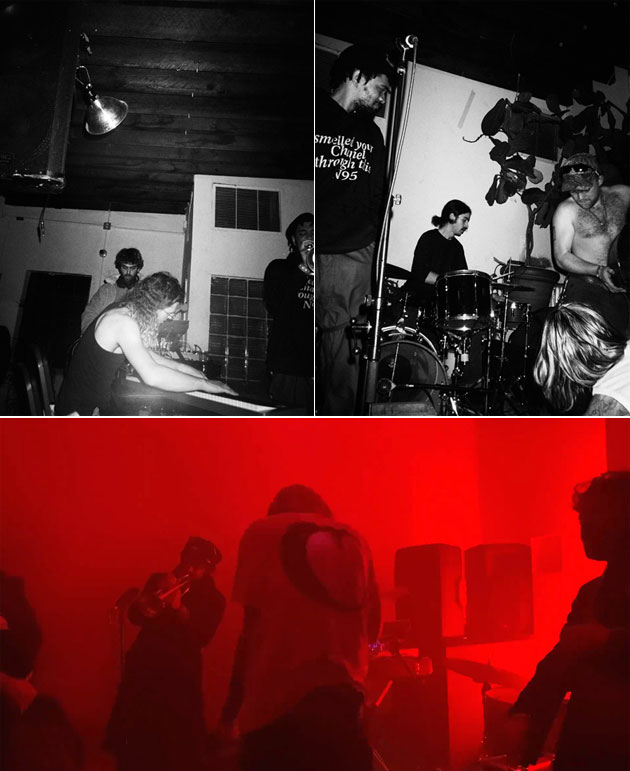
Above left: Ray Toyota on keys, Ben Shirken on guitar, above right: John H Bemis on drums with Nu Jazz at Trans Pecos, Brooklyn, NYC, March 4, 2022, below: Ryan Easter on trumpet, Danny Orlowski singing, with Nu Jazz at IRL NYC, Brooklyn, NYC, January 20, 2022
How do you all feel about the current state of music/art in the subcultural communities of New York City?
Danny: I think in my time I’ve seen the diy scene do a 360 degree improvement, meaning some things never change but it’s always moving; however, it is empirically better then when I first started years ago. Whatever though, because quarantine changed it all too. I wish there wasn’t this significant break in the culture and communication of generations of diy scenes, and that we all didn’t have to be absent for so long and continually/intermittently. It makes it harder to connect, but I think we all still manage. I think there is a lot of vapid culture and art that is very in right now (bimbofication is trending, the simulacrum is more appealing then the real thing to people), we are facing a lot of new dangers specific to our time; but I often ask myself is that any different then always? It really depends where you look. There’s so many younger kids doing interesting stuff and saying fuck you to tired shit, so that gives me hope. Meeting the jazz community has given me a lot of hope because people are there for the music, and it feels a bit opposite to that of the rave scene right now (which I still hold in the center of my heart). I think any scene or project that runs on irony, or anything other than genuineness, is doomed to fail; so with this in mind, I sleep pretty well.
Ray: Ah, this question. Inevitably if you make music in NYC you’ll be asked to be an authority on everyone else’s lol. I think everyone is great. I think everyone is trying hard. I think a lot of old boundaries from 10 years ago have disappeared. I would say personally these days I’m much more excited to meet people who I fuck with who make music that I don’t like than the other way around. It’s an exciting time to be a musician or a fan of live music in New York City.
Kevin: Man, that’s a tough question… Obviously things have been pretty chaotic and unstable feeling coming out of this covid thing and the political state domestically and abroad, and I think that’s taken a toll on a lot of us. I can personally say that oftentimes it’s made me ask myself if I should even be doing this music thing… I kind of feel like a year+ of no music showed us that it’s not really necessary for survival, and sometimes it almost feels self indulgent at worst and like unnecessary chatter at best.
On the other hand though, I feel like a lot of us have become much more aware of our places as musicians and artists, which is great. I’ve always felt like I’ve been in a constant musical gray area… too out for the straighthead jazz scene, too lit for the modern improv scene, I play an acoustic instrument so I can’t really be a raver, and I’ve already done the punk thing. These days that’s not really such a bad thing in my mind. Obviously things can be pretty bleak right now, but due to the constant chaos we’re experiencing on almost every level, now is kind of a great time to be in the gray areas because it seems like everyone is so open minded, incredibly eager to enjoy themselves, and very much seeks out music they’ve never heard before. It allows us to build bridges in scenes, hence why Nu Jazz even exists. These “gray areas” also allow us to explore uncharted musical territory that lives between the cracks and has never been played or heard before, which to me is what it’s all about. It’s a trade off, approaching music and life this way can be unsettling and confusing at times, but if you can keep your head and concept together, the music will reward you!
Furthermore, in a place like New York City, there’s always going to be a zillion bands and artists which can be daunting, but at the end of the day is a very good thing. It’s great to see that in spite of all of the reasons we have to be unhappy, people, kids, whoever, are still starting projects and trying to get out there and put on a good show. Sometimes something might not be super well executed, which is still great if someones trying, and when something is well executed, it always lights a fire under my ass and inspires me. God help me if this ever stops being dope and amazing to me. I just try to be supportive of everyone at the end of the day, because most people will never ever experience anything like playing music with and for people and we’re all incredibly blessed to be able to do so.
Ryan: I recently moved here from Virginia, but I’ve frequented NYC for years, especially having lived in Boston for a few years. One thing that New York City organically invokes is a strong sense of culture. Art and music are the most immediate identifiers of many cultures, and a city as dense and various as this is perfect for housing and supporting a nearly infinite amount of perspectives. Walking into the first show I did with Nu Jazz (November 2021 at IRL), there was a great warmth seeing how a such a style as ours is so well-received and sought after. While NYC carries the same burdens as the rest of the world when it comes to the arts, such as budget, outreach, internal support, structure, etc., this city is a couple of steps ahead in nearly every way.
Ben: It’s a renaissance, baby!!!! I’ve found that a lot of artists have really put aside their differences and musical preferences during this past year in order to relate to one another better and grow stronger communities. It’s most definitely a pandemic related occurrence, and it feels like individual, more closed off scenes have started to blend in with others, blurring stylistic lines. There are still hard edges in place though, and this is not to say that everything is one big melting pot. I still see defined lines and boxes, I just love to see the hardcore heads hanging out with the techno and ambient heads, running into the indie heads. We all have a lot to learn from one another. I started a record label and performance series called 29 Speedway in 2020, and our main concern is creating a community around avant garde music styles and multimedia art, specifically relating to new technologies but not limiting ourselves to a specific avant garde. It’s a more accepting view of things I think, because the institutional view of art and the way it is presented is often very dry, removed, gatekeepy and predictable, whereas doing things on a d.i.y. level can lower the barrier of entry and permit for more artistic freedom because it is both affordable and accessible.
John: Every artist I know is more focused and driven to make things happen than ever before, and it feels like everyone’s trying to step out of their own comfort zone and learn new shit. But It’s really the audiences that have made it for me since quarantine; i sense a strong desire for variety something daring, exciting, spontaneous and different from night to night, whether its a hardware techno set, chamber group or hardcore band. Nobody wants to be in one “scene”, a lot of those lines of “style” have disappeared for the better. There’s a genuine willingness to be challenged and taken somewhere by a performance that’s returned, and it feels really special to play in front of people who are so enthusiastic, open minded and discerning.
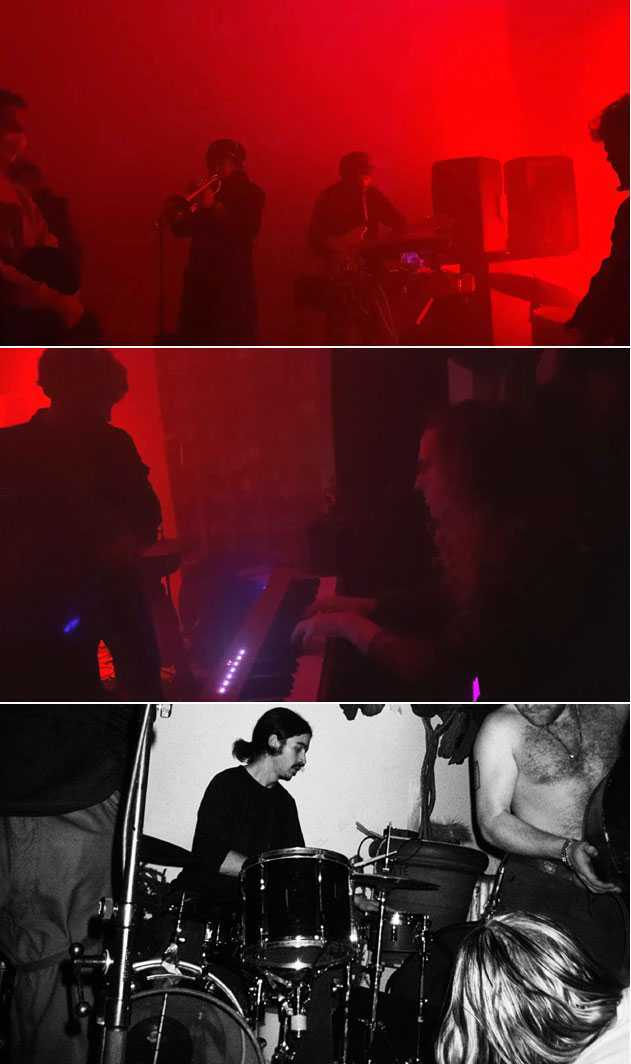
Above: Ryan Easter on trumpet and Ben Shirken, guitar, with Nu Jazz at IRL NYC, Brooklyn, NYC, January 20, 2022, center: Ray Toyota on keys with Nu Jazz at IRL NYC, Brooklyn, NYC, January 20, 2022, below: John H Bemis on drums, with Nu Jazz at Trans Pecos, Brooklyn, NYC, March 4, 2022
I ran into Kevin at rash recently and we briefly spoke about how he was into punk before jazz and found that to be really creative and interesting. Given your diverse backgrounds how do you feel yours fits in to the Nu Jazz project?
Kevin: I’ve been blessed enough to have played with bands ranging from bluegrass and country to hardcore and hip hop, but the vast majority of my playing has been jazz, straight up motherfuckin’ jazz, and more experimental “jazz adjacent” sort of stuff. I’ve played about a s#%! ton of these types of gigs, so playing in these open, groove and dynamic based contexts truly feels like home sweet home to me. In regards to how this fits in the band, I’m very confident in my “fundamentals”, so chops and shreds aside, I try to be an anchor, a listener, and a provocateur all at the same time, and ultimately serve the music in the best way possible.
The one downside of some modern improv music (and I really don’t mean to talk smack on anyone because there are countless amazing practitioners) is that sometimes there’s not really too much aesthetic or style to it, which is something that’s very important to me having grown up in punk and DIY scenes and all. I feel super grateful to be playing in this band because not only is everyone incredibly talented and super serious about their craft, but all my bandmates are such amazing stylists as well. Like everyone has such a knack for drawing up such deep music from their experiences as individuals and from our relationships with one another, and then the skill to translate all of that into clear musical ideas. There very much are six distinct and imposing musical personalities in the room with worlds of different experiences, but somehow it works incredibly well on both creative and technical levels. Very rarely does it go this way… one really can’t take these things for granted!
Ray: This is really the interesting part of our band, because we do have such diverse backgrounds and the threads that led us to this music are woven into a bizarre fabric that I absolutely adore and feel privileged to try on every once and a while. Several of us have experience playing “real” jazz, but I don’t think those influences are necessarily what makes the project click or what makes it fun for us. Think about the people who invented jazz over 100 years ago, these were truly those on the margins of society building and ideating upon their varied traditions with the goal of creating something truly new. It is in that tradition of progress that we present ourselves humbly before you today, and offer our deepest gratitude to those who came before us.
Ryan: My role in the group is being a supporting voice. Being a trumpeter, we’re naturally balancing ourselves between leading and supporting roles, while also tailoring approaches depending on the environment. With an affinity for Don Cherry, Ambrose Akinmusire, and The Mars Volta, I think the aural training alone is enough to find where I can fit into the setting. Then there’s the verbiage. Coming from a hip-hop background, I’m also a hype man in the group. Listening and learning Danny’s lyrics while performing or rehearsing is integral to my approach; I can’t shout back the wrong lyrics, so to speak. Spending time arranging orchestrally, I enjoy using that perspective to figure out new ways to approach placing myself into each song.
John: For as wild and multi-dimensional as the music gets, Nu Jazz feels very at-home for me, and has me returning to my earliest sources of inspiration. Growing up I was super into the Dead and Phish and started drumming the minute my dad turned me onto cats like Mahavishnu, Yes, Weather Report, Zappa and King Crimson; when I was 13 I heard DJ Rashad and Autechre for the first time, fell in love with jazz, and my cousin Annie burned me 100-something CD’s of her favorite extreme metal albums; music from these worlds informed my development since heavily. Over the past few years, simultaneously studying the drum set through jazz and playing in Murderpact (shoutout Hampton Albert, my brother and guiding light), I’m trying to hone a wide dynamic range, from brushes to blast beats. I’ve always loved improvisation, methodical weirdness and maximalism, control and chaos, and Nu Jazz is a great opportunity to embrace these things all at once, especially in the rhythm section, where i’m forced to really step up my jazz chops while bringing everything else into the fold; it’s a rare chance to swim between totally disparate schools of drumming, from Tony Williams to Dale Crover to to Ziggy Modeliste, often in the course of a single song! I’m humbled and grateful to be a part of something where it feels like these disparate impulses and influences are not just welcome, but part of what animates our music.
Kevin Eichenberger is a musician that’s at his best when in between the cracks and blurring lines. Since age 15, growing up in the Blue Ridge Mountains, he’s found himself playing in dozens upon dozens of bands ranging from hardcore punk to experimental rock to bluegrass to soul to classical, and most importantly, jazz. Somehow after a decade of constant performance these pieces have added up to the somewhat odd musician he is today… not really any of these in particular, yet somehow all of them at once. In years past he could be caught performing nonstop with jazz greats such as John D’earth, Charles Owens, DJ Harrison, Corey Fonville etc, though now his primary focus is writing and performing original music with bands like Nu Jazz, CGI Jesus, Beak Trio, Seven, and Yay Spray. Kevin’s musical journey has been one of constant learning and growth. Never really one to take the spotlight (it’s hard for bass players), or at least not intentionally or until recently, the core of his artistry lies in the experiences he’s gained through the bonds he’s formed with musicians and people across all genres possible and all walks of life. His deep love and appreciation of this is his main source of inspiration and why he’s known for such fiery performances. Though his medium and skillset is somewhat outdated and borderline irrelevant (acoustic bass/improvised music), he makes up with a deep understanding of his craft, a sharp focus on beautiful, purposeful, and organic music, and the humility to always strive to place the music and listener above his own ego. Though not well known, he’s very blessed to get to do what he’s able to.
Ben Shirken’s work as Beshken began to draw attention when he was just 16, quickly becoming their full-time career. Now 25, Ben finds himself trying to reclaim the project from his younger self. Ben partnered with Venezuelan visual artist Pedro Bello in developing an animated alter ego for the project named Mimo, or ‘mime’ in Spanish. A catlike jester who exists within a world of critical stares, his actions closely surveilled. The album artwork for Pantomime shows Mimo watched by his surroundings, a vortex of unblinking eyes. Much of the album came together out of improvisational jams with his past schoolmate from NYU Clive Davis Institute of Recorded Music and modular synth enthusiast Jason Park, Eastman-trained drummer Matt Bent, (whom he bonded with over a shared love for jungle and late 90s IDM), and classical pianist Jose Escobar. The group worked mainly out of their shared Ridgewood, Queens studio named 5950 where Shirken resampled, reconstructed, and remixed what they played. Always looking to explore new creative terrain, Ben can be seen playing modular synths in a handful of New York based bands including Nu Jazz (an avant garde jazz-punk ensemble that includes all members of Deli Girls). Growing close with the Brooklyn animation scene, Ben continues to score animated short films. One of which, Dice, a short work by Spencer Sherk, was recently screened at BAM in Brooklyn. Collaborating with artists across various disciplines is a large part of Ben’s new creative process, his work becoming increasingly more multimedia and interactive.
Ryan Easter (trumpet), born in Richmond, Virginia, has been an instrumentalist, composer, and educator in many realms. Graduating from the Berklee College of Music in 2014, he’s pioneered groups such as The Trap Music Orchestra and Tiger Speak, while having shared the stage with the likes of Talib Kweli, E.P.M.D., Donald Harrison, John Daversa, and more. In his spare time, he twiddles his thumbs wishing for more spare time.
John H Bemis is a musician based in Brooklyn, NY. Best known for his role as founding member, drummer and composer in NYC experimental due Murderpact, Bemis is a student of jazz and extreme music seeking to fuse his world of influences into a singular, mixing approach.
Clara Joy (21) (http://www.instagram.com/clrajoy): based in NYC is a known downtown recording artist. Between ages 12 & 13, from an art-studio in a converted mill building, she launched a wildly successful online performance-photo project, SoftOceans, for which she also designed & fabricated hand made clothing-art — selling hundreds of pieces to an audience of over 21,000 people. At age 13, as a working photographer, she professionally documented the artist Alison Knowles for curator Hans Ulrich Obrist. By age 15, she was engaged as a correspondent to cover the Frieze Art Fair recreation of George Maciunus: Flux Labyrinth (1970/2015). She began recording songs as Clara Joy in 2015, with 7 albums and 2 singles released to date, which have earned critical acclaim. Intervening band culture, she appears alone on stages, yet has incited multi-artist concerts in the streets. In 2019 Clara Joy was featured in Humans of New York. During 2020, Part of Something (2021), the first film about Clara Joy was made by Sophia Johnson and debuted in 2021. Most recently, Clara Joy is documented performing with artist Alison Knowles in her feature length video reading of The House of Dust presented in Wiesbaden, Germany in 2021 at the construction site of the artist’s corresponding 3D printed building. Clara Joy was a 2021 invited performer for the Brooklyn Rail’s event dedicated to Nam June Paik and inaugurated the sold out reopening concert of Elsewhere in East Williamsburg, Brooklyn. More at http://www.instagram.com/clrajoy
Mina Cheon AKA Kim Il Soon
At Ethan Cohen Fine Arts, Chelsea
CHOCO·PIE PROPAGANDA
January 23rd, 2014, New York City
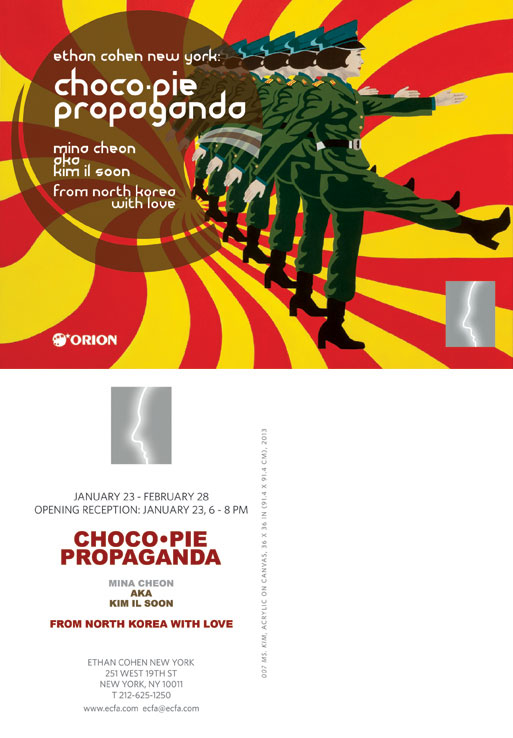 Seen on announcement: 007 Ms. Kim, acrylic on canvas, 36″ x 36” x 1.5 by Mina Cheon AKA
Kim Il Soon at Ethan Cohen Fine Arts. Exhibition: “CHOCO·PIE PROPAGANDA”
Opens: January 23rd, 2014, Chelsea, New York CitySWEET ♥REVOLUTION
Mina Cheon Dictation Kim Il Soon
January 17, 2014
On my mother’s birthday.
As a Korean, the idea of having two artistic identities, South Korean Mina Cheon and North Korean Kim Il Soon, is an obvious reflection on the country’s state of being divided. It makes all the sense in the world that if a country is split so should the artist in practice. As a political pop artist, I’ve created artworks that responded to the global political climate, using pop imagery that circulates on the Internet, news, and entertainment as the source of my work. As a South Korean new media artist Mina Cheon, the political pop art (Polipop) includes the perspective of a South Korean-American who travels between the East and West, bringing out things that usually go unnoticed or said in media culture. As a North Korean social realist painter, Kim Il Soon lacks access to technology and adheres strictly to the propaganda painting style of North Korea.
While the Korean peninsula may be demarcated by a 38th Parallel, the Demilitarized Zone (DMZ), the history and culture is nevertheless shared, the country is united by one country’s people and language. Moreover, Korea is ubiquitously tied by the never-ending heated debate on reunification and national identity, whether we are at war, armistice, trade, or peace. This is our business.
The world may find our country (countries) amusing, the radically divided, globally useful as separated communism and capitalism states, fanatically obsessing over sports or military or pop culture. Our history is made by other countries and cultures, the Western influence has been severe, whether through China, Japan or America, it makes sense that other worlds and countries deem to hold stake at what should remain – a country divided – and what shouldn’t happen – reunification. Who are those who dictate what should happen? Who are fit to lead the way towards unification, when cultural divides remain not only from South and North but also between East and West, and even between the left and right politics.
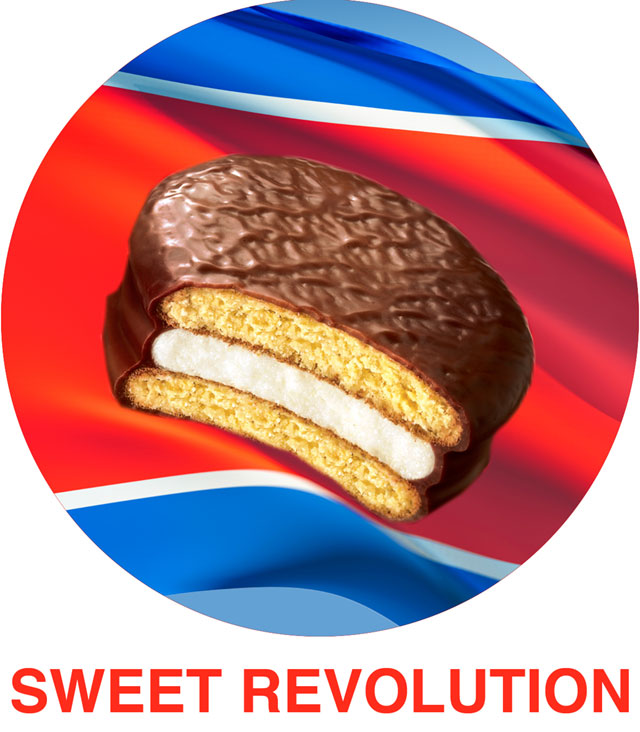 Sweet Revolution, graphic inspiration behind Let’s East Choco·Pie Together, a 10,000 piece Choco Pie Installation by
Mina Cheon AKA Kim Il Soon at Ethan Cohen Fine Arts for “CHOCO·PIE PROPAGANDA”, 1/23/2014, Chelsea, NYCWhat does economy have to do with it? Probably everything. It benefits some for Korea to be separated; it benefits others for us to unite. Mostly, humanitarians would like to see Korean reunification for the purpose of global peace. We are those people, Kim Il Soon and Mina Cheon, and everyone else who support the cause of this political pop art campaign which include the slogans and ideas, “Eat Choco·Pie Together,” “Squirt Water Not Bullets,” and “Make Art Not Missiles.”
In 2004, I traveled to North Korea from South Korea, busing passed the DMZ with very large windows without curtains so that North Korean military soldiers can see us through the glass. The tour was to the glorious and mystical Mountain Kum Kang San, a place that is now forbidden ever since 2008, when a South Korean female tourist was shot twice by a North Korean officer for straying her path. With the same name as the number one Korean restaurant in New York City, the Kum Kang San Restaurant in K-town where you dine Korean BBQ over a massive faux mountain made out of Styrofoam and a mechanically pumped waterfall, the passing into North Korea was its own simulacra, a copy without an original since the sky seemed bluer, the mountains looking just like the images we are so familiar with through posters and calendars of hallmarking beauty of North Korea. Being at the actual site only reinforced the image of the place, it was all a reproductive moment. And the woman who got shot, could have been me, as I am told repeatedly.
While the tour was restrictive and highly programmed, my direct interactions with North Koreans were nothing like the axis of evil, uncle killing, actress raping, fan of Dennis Rodman, rogue enemy. Instead, they were warm. I felt akin, like being with my own family, they were like sisters, and like my mother, who after all was from the North and came down to the South at the brink of war.
Many of the North Korean female workers around the Kum Kang San’s Hyundai Resort, or even the security were friendly. They called me “unni” meaning older sister and even showed signs of affection by slightly holding my arm when speaking to me. I did not feel foreign in this country.
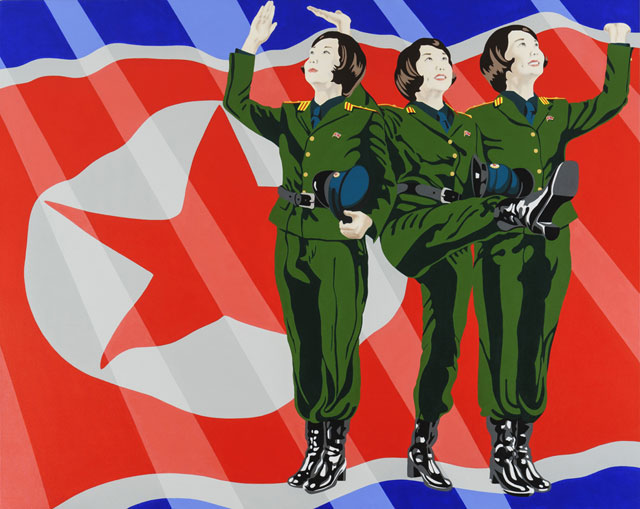 Three Graces, acrylic on canvas, 60″ x 48” x 1.5 by Mina Cheon AKA Kim Il Soon at Ethan Cohen Fine Arts
Exhibition: “CHOCO·PIE PROPAGANDA” Opens: January 23rd, 2014, Chelsea, New York CitySoon after my trip, I started creating my first series of political pop art on North Korea with a series of 99 Miss Kim(s) doll installation of North Korean military femme bots that superseded American Barbie dolls in beauty and appearance, as well as an interactive media installation piece, Half Moon Eyes that archived all the videos from that trip, including footages that I had to retrieve back after confiscation. The term “half moon eyes” references the shape of North Korean female eyes that make them remarkably beautiful. The work I did then was dedicated to my mother whose maiden name is Kim, as well as all of the Kim names of North Korea. Miss Kim was also myself, as a Korean embodying North Korean history.
By 2012, it was no accident that meeting Ethan Cohen who also has a history with North Korea, encouraged me to elaborate further with Miss Kim, Ms. Kim Il Soon. Her name Kim Il Soon bequeath to her by the supposed Dear Leader, means “eternal purity” and sounds similar to Kim Il Sung, founder of the Democratic People’s Republic of Korea whose name means “eternal sun.” Kim Il Soon is a nationally recognized painter, which means she has a bit more artistic freedom than some. She is also a two-starred Lieutenant Commander, scholar, devout citizen, hardworking farmer, a mother of two, and most importantly, a human being.
The artwork created in this persona is a deliberate political move, the art is activism that brings awareness about North Korea and it is Kim Il Soon’s intension to resume painting until Korean reunification. She is my artistic persona, alter ego, a new media avatar, and this is our performance. With the work ethics of a good North Korean, Kim Il Soon spends a hundred hours with each painting. Since she is recognized as a national painter, she has assistants, but nevertheless labors over the work.
Kim Il Soon appeared publicly in the United States for the first time during the Pulse Art Fair in New York 2013 with Ethan Cohen New York, and the painting Sons of Joseon: Squirt Water Not Bullets was exhibited alongside her performance, as she passed out political peace buttons. North Koreans call their nation “Joseon” but they do not directly relate themselves or acknowledge the history of the Korean Joseon Dynasty. The two boys in the painting is her son Kim Si-un, and the doubling of his appearance signifies the twin effect, a country split into two. This painting was soon thereafter acquired by the Smith College Museum of Art, and housed in the contemporary art section, a fitting place for housing their very first North Korean female artist’s work.
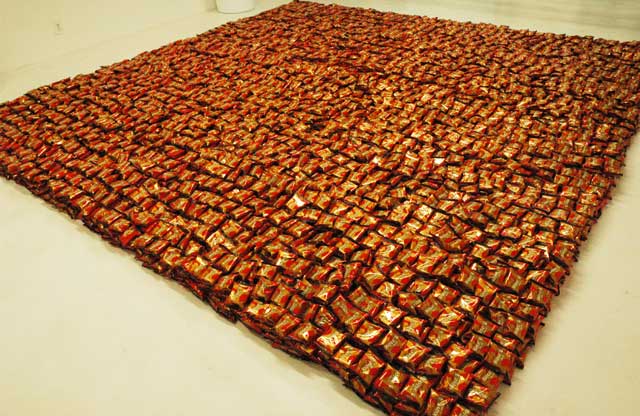 Let’s East Choco·Pie Together, 10,000 Choco Pie Installation, 153″ x 159″ by Mina Cheon AKA Kim Il Soon
Site specific, interactive, audience participation installation. Installed at Ethan Cohen Fine Arts,
Sponsored by Orion Co., Korea. Exhibit: “CHOCO·PIE PROPAGANDA” Opens: January 23rd, 2014, Chelsea, NYCSo, here we are. Kim Il Soon’s very first solo exhibition at Ethan Cohen New York gallery opens. In varying sizes, her paintings resemble North Korean propaganda posters. In Happy North Korean Girl, she proudly poses in front of the DPRK flag. She is happy because she can serve her nation with pride. In 2011, the North Korean Chosun Central Television announced the results of a new global happiness index reported by the national research team, and it states that North Korea is the second happiest nation aside big China which is supposedly the happiest due to the mere number of people; South Korea being in the 152nd place and “the American Empire” in place 203, which would not be a surprise if it was dead last place.
The paintings of Happy North Korean Little Boy and Happy North Korean Little Girl show Kim Il Soon’s children, Kim Si-un (son) and Kim Si-a (daughter) who sing their hearts out for their country on stage. While blessed with two children, Kim Il Soon is only married to the state, and by default married to the Dear Leader, in perpetuity.
Another painting In Honor of The Great Dear Leader Father includes Kim Il Soon raising the red flag under the blazing sun of Kim Il Sung, and other Dear Leaders appear in other paintings such as in Strength and Military, where Kim Il Soon holds a North Korean rifle while embracing a portrait of dictator Kim Jong-il in front of an industrial complex. In the painting Lil’ Kim, the February 2012 Times Magazine’s front cover of Kim Jong-un is framed while Kim Il Soon is taking notes and sketching in her little red book.
From other paintings such as the Three Graces that reference Western beauty amidst a North Korean flag to Kim Il Soon as a farmer in The Seven Years Plan, the doubling and tripling image of self signifies the multiplication process in reproductive culture, lacking individuality and promoting collectivity and succinctness in unity repeated in North Korean imagery. Whether lining up in painting Line Up or spiraling in 007, Kim Il Soon includes herself into North Korean military iconography that includes the “Juche” ideology that one is all and all is one.
And, whose Choco·Pie is it?
The installation of 10,000 Choco·Pie for the audience to eat was kindly donated by Orion Co. in support of the installation Eat Choco·Pie Together that promotes Korean reunification and global peace. Kim Il Soon unconsciously exposed to the outside world, had her Duchampian moment of making a good decision. Duchamp selects a toilet and she selects a relevant intercultural consumer object of our time, the Choco·Pie.
This South Korean moon pie-like confectionary has become an overnight sensation in North Korea as a smuggled favorite snack and is worth three bowls of rice, and favored especially by the elite class North Korean women. Comparable to the American Twinkie, Choco·Pie has been sought after in North Korea, ever since South Koreans gifted Choco·Pie to the North Korean laborers at the Kaesong Industrial Complex as a token of appreciation. Symbolically, the Choco·Pie has opened up North Korea and formed a loving exchange between the North and South, something that even the Korean governments have failed to do. Truly this is a postmodern co-national co-operation, one that is a viral and an addictive kind.
The Chinese character “Jung” on the packaging means love and friendship. Choco·Pie is ours to eat, for North and South Korea, and for America – Let’s Eat Choco·Pie Together – for “Han guk” means “one country,” not Republic of Korea, not Democratic People’s Republic of Korea. This is a “Sweet Revolution.”
The exhibition “CHOCO·PIE PROPAGANDA: From North Korea with Love” by Mina Cheon aka Kim Il Soon is showing at Ethan Cohen New York (ECNY), opening January 23, 2014 at 6pm and up till February 28, 2014. ECNY is located on 251 W. 19th St, between 7 and 8th Ave, New York, NY 10011.
http://www.ecfa.com/
This article will receive periodic updates. Check back for additional images and downloadable content.
Pat Badani at CAA
In Conversation with Media-N
Journal of the New Media Caucus
College Art Association Conference
Chicago – February 2014
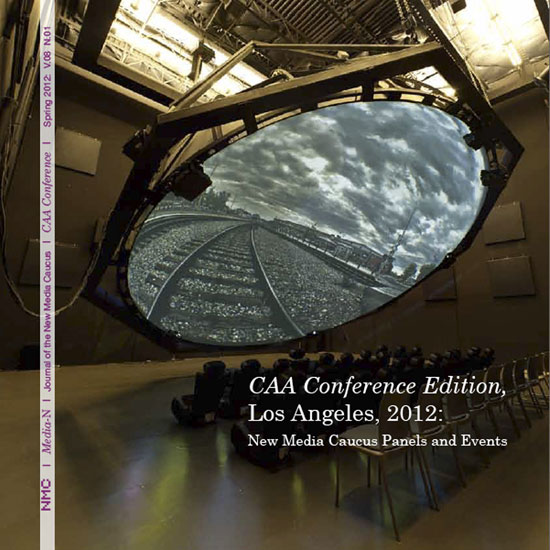
CAA Conference Edition, Los Angeles, 2012, Media-N Journal of the NMC, cover of the summer print edition, 2012, V.08, N.01.
Excerpts From The Interview
Chicago – February 2014
Preview & Download The Entire Document Below
Joshua Selman Interviews Pat Badani, Editor in Chief, Media-N Journal
While attending the College Art Association Conference at the Chicago Hilton, February 11
th to 15
th, I was embedded in a special community made up of scholars in art education, art history and art criticism. The annual conference itself aims to “cultivate the ongoing understanding of art as a fundamental form of human expression.” (“About CAA.”
College Art Association. 11 Nov. 2004. CAA. 25 Oct. 2010:
http://www.collegeart.org/about/mission ) With over 13,000 members CAA’s influence is international in scope, and this year I engaged one of its most interesting affiliates: The New Media Caucus, a nonprofit, international membership organization that aims to advance the conceptual and artistic use of digital media (
http://median.newmediacaucus.org ). It’s been gratifying to learn just how modest the organization’s online description of its mandate is. While The New Media Caucus does advance the conceptual and artistic use of digital media, its premise has evolved with very far reaching implications. For The New Media Caucus, the internal definition of new media practice is dialectic in that the NMC is prepared to re-define its scope as new media evolves throughout time.
Pat Badani, the Editor in Chief of the Media-N, Journal of the New Media Caucus, is working with me as a correspondent at CAA. Together we have launched a discussion – from within the conference – to examine what is happening at CAA this year as it applies to the New Media Caucus, to Media-N Journal and to CAA members. I am very pleased to present this conversation with Pat Badani, who is an arts practitioner, educator, curator and editor, with an MFA from the School of the Art Institute of Chicago. Pat is on the executive board of the New Media Caucus and is an ISEA International Advisory Committee affiliate. I have joined The New Media Caucus and personally attended each of their CAA Conference presentations onsite at the Hilton in Chicago, as well as each special NMC offsite event and exhibition concurrent with the conference.
The following excerpts from my conversation with Pat Badani give a hint of what is in the full interview. Please scan through it using the viewer below and download the PDF to save and view it for a full reading.
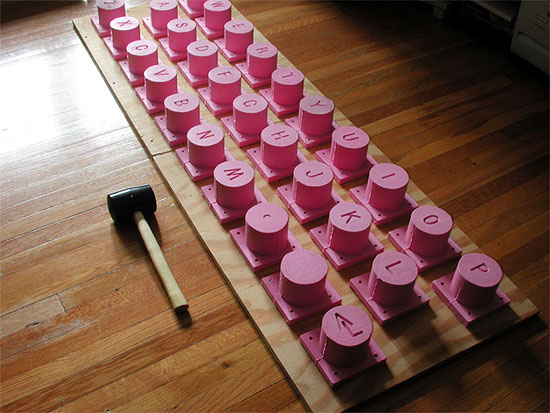
Sledgehammer-operated Keyboard, 2005 – ongoing, Taylor Hokanson,
Human-Computer Interface, © Taylor Hokanson.
JS: Are the New Media Caucus members exclusively those teaching in college and university departments of new media and are the New Media Caucus members exclusively working with New Media Art?
PB: The membership is definitely a mix of digital media practitioners and academics. To the second part of your question, we have a constitution that defines new media as an experimental form that is always reinventing itself. We define it both in specific terms and as an open-ended idiom, because we know that new media will evolve five or ten years from now.
JS: The
Media-N Journal, as it stands today, follows a familiar and very manageable presentation format in that it’s both in print and online. Everyone should make sure to download a copy, if they haven’t ordered one already,
here. The experience of the print version is quite rich by comparison to the online version, which is mostly scripted html. How do you see where you are now with formatting the journal and where you might be in the future?
PB: Interestingly, this is something we discussed in a closed Media-N publication sub-committee meeting during CAA. The format we now use is WordPress online, and a print-on-demand edition designed by very talented graphic designers. Online, there is a way of extracting an Adobe pdf directly from WordPress, but we decided to work with our designers on beautiful, collectible, books. We’re perfectly aware that we have an online version that’s open access. Yet we also have a collectible, precious object, for purchase at a reasonable price. The more we talk about moving into other publication formats, we’re developing our philosophy beyond “pixel versus paper.” Why not have a series of publication formats and subjects within the Media-N Journal, with that branding? Some of them could be electronic publications that come out of our new media exhibitions; they could follow – or disrupt – the catalogue format with critical essays by artists and historians in addition to artists’ statements and the work itself. That could be one of many forms as added publication formats.
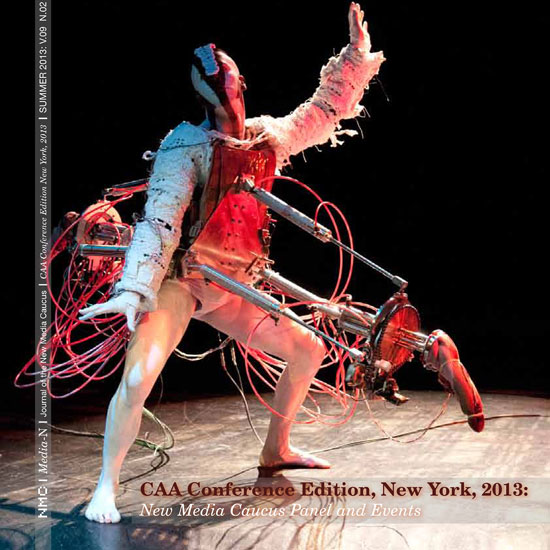
CAA Conference Edition, New York, 2013, Media-N Journal of the NMC,
cover of the print summer edition, 2013 edition, V.09, N.02.
We are also looking into publishing through SCALAR, an open source platform created by a team at USC that allows for media rich investigations and publications. It supports a type of journal where users can chart non-linear paths through multi-modal, modular, Web-born content and media. We might also develop a publication that does not necessarily follow the strict academic format, which is what we have right now. It has to be said that we’ve been working for several years in order to perfect our current format. Why? Because it serves our constituency, made of large numbers of academics that can use our publication as a way to obtain tenure and promotion. The essays we currently publish meet the strict academic specifications for tenure and promotion packages. Beyond that, researchers, educators, students and artists use our publication as a reliable resource. So, we do serve a purpose by publishing a traditional academic journal. However, there are many other interesting directions for us to include. It’s not a matter of dropping what we’re doing, because it does serve a purpose, but rather, adding other forms of publications that allow various types of voices and representations.
JS: How do you see the strategic partnership between Artist Organized Art, the New Media Caucus and the Media-N Journal? What do you see on the horizon that could evolve through the two organizations, which have very different missions?
PB: It’s interesting to give new media an outward facing stance. With new media, as with photography in its day, with video in its day, and with performance, in the initial decade in which emerging practices and technologies are being experimented with, the artist faces a number of problems.
Number one: Access to the technology. This creates camaraderie between like-minded individuals who share technology, discuss and improve upon it. “I want to learn from you. Or, I want to borrow your device,” etc.
Number two: Our art practice imposes difficulty with showing and disseminating our work due to lack of technology support. In addition, there’s lack of interest on the part of institutions, and lack of a viewing or participating public. Contemporary art curators often lack interest because of a lack of familiarity with our language and with the technology. So they often opt out of showing us, or including electronically controlled art work in survey exhibitions. Ultimately, bodies such as journals, magazines and books, won’t touch us because they’re missing our reading public. So, new media artists are kept out of the “cultural market,” let alone the commercial market. The cultural market makes it possible to be seen – understood – mediated. Thus, the isolation of new media gives rise to particular platforms such as festivals, symposia and specialized publications. Things become grounded and formalized, typically in the second to third decade of practice, when the practitioners themselves have developed theory, developed programs within universities and designed courses of study, and validation platforms like exhibition and publication environments. There is a point when the “new” media joins mainstream art. The initial problems are eliminated for the most part; the language being used by these artists becomes part of the mainstream. Then, predictably, a newer media emerges, a newer technology, or a newer practice and a newer community of inquiry seeks its proper enclave.
This has been happening with electronic technologies for a number of years. I think now we can safely say we’re gradually becoming part of the mainstream, in that the mainstream is actually talking about us in both negative and positive terms, but while we’re being considered by critics, by curators, by directors, there is ambivalence.
I go to a lot of festivals, a lot of symposia where there is a conversation being held right now by individuals who are in significant editorial and curatorial positions of new electronic art, writing books and curating exhibitions, who are less practitioners, but work more in a theoretical realm. What I hear them saying is that the divide between media art histories and art history needs to be addressed. How do those two realms come together? I think we are at that moment in history where we will increasingly see a co-mingling, a cross-referencing of the art theories and histories. Artists are already doing it, and in my view, critical theory has to support practice.
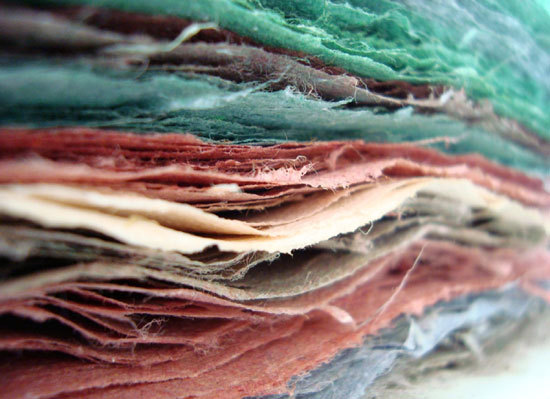
Stack of Open Source Paper, 2009, Denise Bookwalter, Anna Child, Laurie Corral,
Brooks Edwards, Cutler Edwards, Lyman Edwards, Bridget Elmer, Stacy Elmer,
Andy Grace, Rashmi Grace, Mark Greeley, Emily Larned,
Sam Nichols, Jessica Peterson and Emily Tipps,
handmade paper, Copyleft Flatbed Splendor.
JS: Would you agree that a minimum benefit of submitting a paper for consideration, even if it’s not selected, is to receive valuable feedback, pertinent to the submission?
PB: Yes, very much so. We’ve been thanked over and over again for doing that; especially by certain authors who may need experience with publishing. One of Media-N Journal’s missions is to mentor young scholars. One method as Editor-in-Chief is to ask an associate editor to act as supporting editor for the guest editors. We consult on editing submitted essays, so that development is coherent and top quality. Scholars, particularly younger scholars, are usually delighted to work with us in this way, because of the learning process and the camaraderie that we establish in the process.
JS: You’ve described a balance of separate and mutually supporting selection processes between the CAA Conference presentations, the off-site presentations and the three editorial programs of Media-N. As the off-site presentations beyond the CAA Conference grow, what impact will they have on the Media-N Journal?
PB: That’s an area for experimentation, which we like to do. We’ve been talking about doing something very specific, centered on the New Media Caucus, with a regional location for exhibitions, or other related ways to share. For example, we could hold a workshop to share experience with emerging technologies; work with artists, scholars, organizations, directors and curators to measure the potential support for events at their regional institution. Chicago, for example, has a high density of New Media Caucus members. Regions, such as this one, might also call people from Wisconsin, Indiana and other adjoining States. The regional off-site events would be branded as the New Media Caucus, but they might generate their own formats…these ideas are still in the process of elaboration, and it is all very exciting to us! It’s in discussion.
JS: How did working with the multi-institutional hosts CAA, Columbia College and the Chicago Cultural Center benefit the New Media Caucus and Media-N during the CAA 2014 Conference and what role will multi-institutional support take in the future?
PB: It’s exciting to be hosted whether we are joining CAA in New York City, or CAA in Los Angeles, but we also partner with offsite institutions. Sometimes we team up with learning institutions such as Columbia College in Chicago. In Los Angeles we’ve worked with three digital media centers that host our events. It’s important that we present within the CAA context, which is usually in a conference setting in a hotel, but also to present offsite events and round tables. It’s how we round out our substantial program. We are only allowed two panels at CAA itself. That is a CAA rule and as a Caucus we must abide by this limit.
So the benefit, of course, is that it helps the New Media Caucus broaden its reach. It helps us present events and exhibitions that we wouldn’t be able to show at CAA, because we’re limited to two panels. Hosts benefit the New Media Caucus and we also benefit institutional hosts, because we are bringing very unusual material that draws quite a crowd from the community at large and our events are well attended by a community which benefits the hosting institution.
JS: What role can an organization like Artist Organized Art take to help remove the divide between media art histories and art history?
PB: What interests me about Artist Organized Art – the organization itself – is what its title refers to. The New Media Caucus is precisely that. We, as a group of artists, have organized ourselves into a Caucus in order to create a forum for the presentation and distribution of our voices, of our community, of our output as artists, and – for those who are academics – our output as academics as well. What interests me is the notion of artists organizing their position in culture without any supporting structure, without funding, as volunteers. We do this because somebody must. If Artist Organized Art has a similar mandate, and it also reaches a wider community, the affiliation or partnership is of mutual interest, because it allows us to interface contrasting, but aligned, communities.
JS: We focus on many different aspects of a critical jumping off point. How does an artist choose to engage the world. We inquire whether artists choose to address the question. It seems natural to members of the New Media Caucus to question parameters of engagement, but to those working on an MFA in a categorized art form, or for artists working in performance, preparing for a white box or stage is generally accepted right out of the gate. We prepare work around installing in a white box and accept this, letting specialists put out interpretations of our work, instead of conveying our own intentions as part of the work itself. Artist Organized Art supports including many parameters of engagement within the compositional paradigm around structured conditions of art-making. These conditions are conventionally alienated from art practitioners, who are constrained specifically because they don’t include these parameters, and it does effect their ability to develop works. This may not be obvious to New Media artists, because of, on the other hand, the difficulties of finally managing so many parameters.
PB: Actually, we are aware of that, because (..more)
Scan through the pages of the entire interview in this preview: (Turn the pages by dragging them)
Pat Badani
is an arts practitioner, educator, curator and editor, with an MFA from the School of the Art Institute of Chicago. Concerned with the relationship between art and social practice, over the last 30 years Badani has exhibited her work, participated in conferences and panels, and published widely in North and South America, Europe and Asia. She has received over twenty awards and commissions – notably a one-year Canada Council Media Arts research grant in 2001 for her transnational project “Where are you from? Stories dealing with human migration, and a 2012 “Robert Heinecken Trust Fund” for her project “AI Grano” focusing on biodiversity issues related to maize agriculture. Badani has lived in 7 countries in the Americas and Europe and has held academic positions in Canada, France and in the USA. Recent curatorial projects include a partnership with Lanfranco Aceti in a series of panels and an exhibition on the rhetoric and realities of artistic interventions in public space, from performance to Augmented Reality art. Badani is currently Editor-in-Chief of
Media-N Journal, executive board officer with the New Media Caucus, and an ISEA International Advisory Committee affiliate.
Media-N was established in 2005 to provide a forum for New Media Caucus members and non-members alike, featuring their scholarly research, artworks and projects. The New Media Caucus is a nonprofit, international membership organization that advances the conceptual and artistic use of digital media. Additionally, the NMC is a College Art Association Affiliate Society. http://median.newmediacaucus.org/
The College Art Association of America
(CAA) is the principal professional association in the United States for practitioners and scholars of art, art history, and art criticism. Founded in 1911, it aims to “cultivate the ongoing understanding of art as a fundamental form of human expression.” CAA currently has 13,000 members, primarily academics, professors, and graduate students in art practice, history, or theory, including visual arts, visual culture, and aesthetics. Its membership, concerns, reputation, and influence are international in scope.
Artist Organized Art
non-profit works with artists & institutions to support artist organized media, events & cultural education by strategic, collaborative & financial means. As a 501(c)(3) tax-exempt organization it provides strategic support to artists and organizations working in & benefiting communities everywhere in the world. Its current following has an all time high of over 150,000 subscribers. Email announcements reach 75,000+ global arts professionals & their followers: 44% North America, 33% Europe, 23% Asia and beyond. Artist Organized Art is advised by, followed by & supported by some of the most prestigious independent artists, organizers, curators, historians and institutions in the world, including founding members of Fluxus, members of the International Artists Museum and the publishers of New Observations Magazine. http://www.artistorganizedart.org
Joshua Selman
is an artist, composer and graduate of Yale University with a Master of Music Composition whose intermedia practice combines public space intervention, large-scale installation, cultural-strategy and critical journalism. His sound work is included on Westdeutscher Rundfunk, Cologne, Germany. He’s also known for performance works and objects with unique virality. Some were included in a Whitney Museum Ray Johnson retrospective. Other collaborations are with Fluxus founders Alison Knowles and late intermedia theorist Dick Higgins. He first exhibited as An intermedia artist at New York Fluxus venue, the Emily Harvey Gallery. His participation in several artist organized Biennials known as Construction in Process led to a post as Executive Director of The International Artists Museum, New York Center. He’s also documented as a commercial innovator in social networks, by Wired Online in 2004, and referenced in a Facebook patent. In 2003, he launched the online space Artist Organized Art. In 2007, as President, he established Artist Organized Art, a new media based arts organization, as a tax-exempt 501(c)3. In late 2008 he guided Artist Organized Art to acquire New Observations LTD, publisher of
New Observations Magazine, with a mandate to relaunch the seminal arts publication. He has gained long term support for the organization from Google Inc. His networked activities now include thousands of artists in the Americas, Europe, Asia and beyond. Residencies include South Korea, Germany, Australia, Canada, the USA and China. His works in Performa, on the High Line, other appearances and interviews are documented in print, on the we band on television.
Territories of Complexities
Guillaume Paturel
WhiteBox
March 29th – April 5th
Curated by Lara Pan
By Mark Bloch
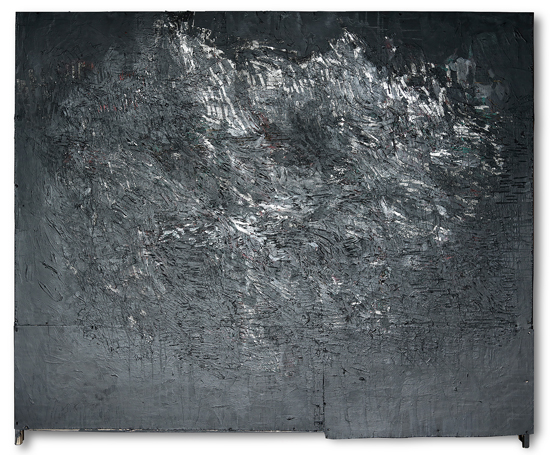
Territories of Complexities. Photos courtesy of the artist 2017
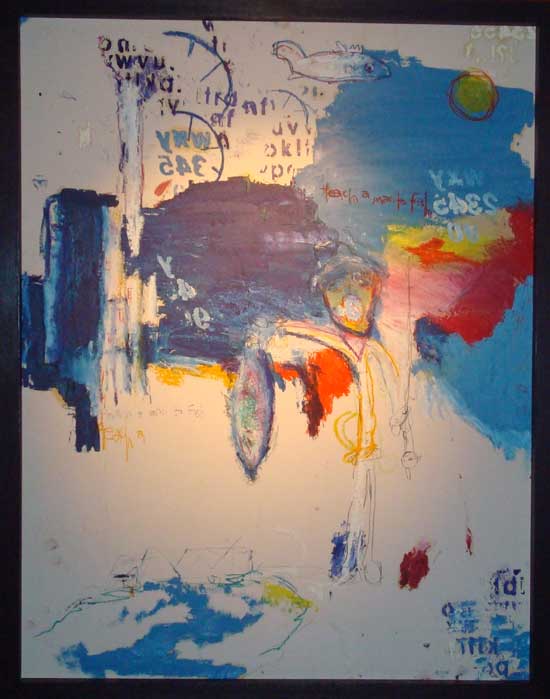
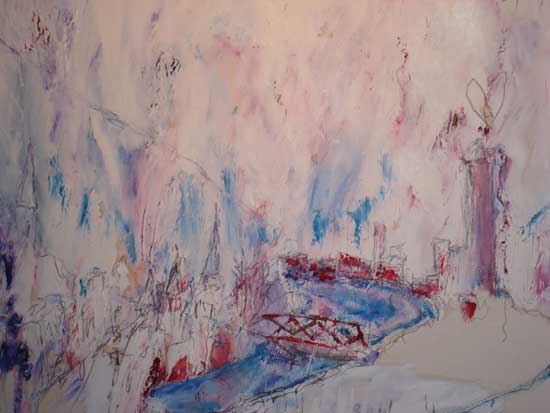
“Territories of Complexities” was an appropriate name for this exhibition at WhiteBox. There was much more going on than met my eye that was not apparent from the start.
The nine large, seemingly squarish, seemingly abstract paintings unidentified by individual names that were exhibited on the walls of this large, squarish, indeed, white box-like space seemed earnest and straightforward. The show was a competent “suite” of works by a middle aged artist making fine art for just seven years after a couple of decades in the field of architecture.
But the more I looked, the more the works expanded within my field of vision. Then a chat with Guillaume Paturel, born in Marseille, France in 1970 and a graduate of L’École des Beaux Arts in Marseille with degrees in art and architecture enhanced my perception further. Finally, a tenth piece, a game changer, was added to the show between my initial visit and the opening, casting in concrete, well actually in plywood, the connection between art and architecture, the artist and his subject matter: surface and depth. It raised the stakes for me as a viewer as it raised the artist’s stratum in which to work from the second dimension into the third.
Though the artist Paturel and the curator Lara Pan, both alerted me that the new piece would be installed before the opening, I was not prepared for what I saw when I reentered the gallery. A striking “sculptural painting,” that Pan called “his first foray into the medium” now expertly occupied the center of the space, displayed close to, but not directly on, the floor, horizontally. This 4” thick solid wood slab had been ground, gouged and burrowed out by a robotic arm to create a topographical 3D object, fabricated directly from a painting now hanging behind it, behind the hand-painted peaks that seemed to be ascending ever so gently toward the ceiling like a hybrid between an accordion and an alien planetary landscape, and like the collaboration between man and machine that it really was. The texture was all machine-made. The inspiration and added color were by the artist.
That painting the sculpture “borrowed” from, and the other eight adjacent to it, were not square I now learned, merely by taking a second look and using my left brain, something not particularly engaged during my first visit. I could see that though similar to each other, these nine paintings, five or six feet across in either direction, were each unique in size, orientation and in the amount of power with which they projected energy into the space, toward the 3-D addition in the center of the room that, as a projection of one of the mostly “flat” works that surrounded it, seemed to bring them all into sharper focus.
Like the work seemingly hovering above the floor, each work on the walls contained silver, echoing the artist’s still thick head of hair, catching bits of light but not reflective. The nine pieces gently fought each other like extra terrestrial weather maps indicating chaotic, violent patterns traveling over coarse, scaly, abrasive, bumpy, scratchy planes aggressively, each supported by its own thick wooden structure and charting its own course. One was all silver. One was black with only silver wisps. Others were speckled and punctuated silver or shiny white or off white with a silvery sheen—with dotted tape textures and other colors emerging from below. Some had their supports painted dull black, others had other colors splattered on them and still others boasted only their raw wood grain as a foundation.
My first impression had not been correct when I first entered the space because their surfaces, seen from afar, appeared regular and monochromatic, polished, possibly smooth, ironed, slippery and fine—like so much of what one sees in galleries these days. But instead, these were what Paturel later described as his ideal: “dusty, ugly stuff.” They were, in fact, bumpy, sandpapery, scabby and cracked. When I asked the French man what he thought of American Ab Ex, he informed me that, to him, his art is not at all abstract. He sees his works as depictions of landscapes, geography, scenery, ground, and landforms. Any abstraction I detected was just the result of layers that courageously cover mysterious terrain underneath, which in turn cover thick skins of maps or guides, both of which alternatively familiar and confounding to the artist, I was assured.
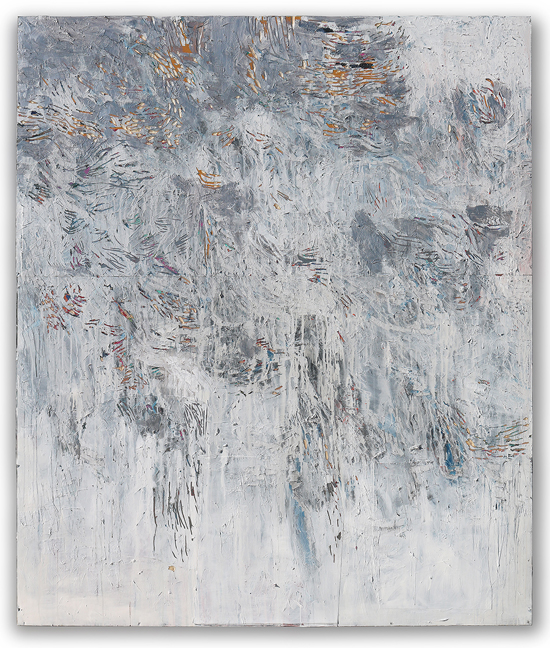
Territories of Complexities. Photos courtesy of the artist 2017
Paturel still produces architectural renderings for some of the world’s top architects. Following the Beaux Arts, Paturel also attended Ecole Nationale Supérieure d’Architecture de Paris La Villette.
These paintings were, therefore, similar to topographical meanderings, but simultaneously important escape hatches from his work as an architect, needed imaginary extensions of the professional work he does for important sites like the new One World Trade Center tower and memorial or a sustainable city in Saudi Arabia. He is a gifted craftsman in both jobs, apparently. He recalls that before he was “tied to a computer” he had created, in a previous version of his profession, architectural renderings using handmade collage techniques with whatever materials were necessary to eek out his visions of practical structures not yet realized.
So perhaps missing that mode of handmade expression, he explains that these less practical works begin with the laying down of aluminum tape, building layouts of non-existant “cities.” His memory wanders through memories of previous projects for sites in The Bronx or Red Hook (where he now lives with his family) or in Dubai, where clients “asked for trees and grass and beautiful greenery” in the architectural renderings, but adds that once finished and he was on site, he witnessed “just landscapes of dirt and sand and policemen.”
And so he applies layers of paint. He scrapes to unearth underlying strata. On their exterior, these artworks show evidence of nicks and cuts and gouges, the surface forcefully indented creating external damage indented and intended and invented.
He told me that he does not favor the slick, cute, happy superficiality he sees in the work of many artist contemporaries. He prefers art like opera, showing passions or deep truths that elude us so I ask for his personal story, hitherto unavailable in my investigations. He looks at me long and hard and finally asks, “Do you really want to know?” I do. He tells me his work is not abstract, so I wonder, what is it? “My art fights death,” he tells me. “Creativity against decay, you know?” He finally volunteers that he is now an artist because he once told a lie then had to fight for his life to make it true.
His father called him to reveal he was fighting cancer one day out of the blue seven years ago in New York where he had moved after decades of them not speaking. From there they carefully rekindled their rocky relationship. Guillaume told him he was about to have a show, but it was a lie; there was no show. He was an architect, never an artist. But after he hung up the phone he went directly to the store and bought art supplies. He next arranged to have an exhibition and set to work.
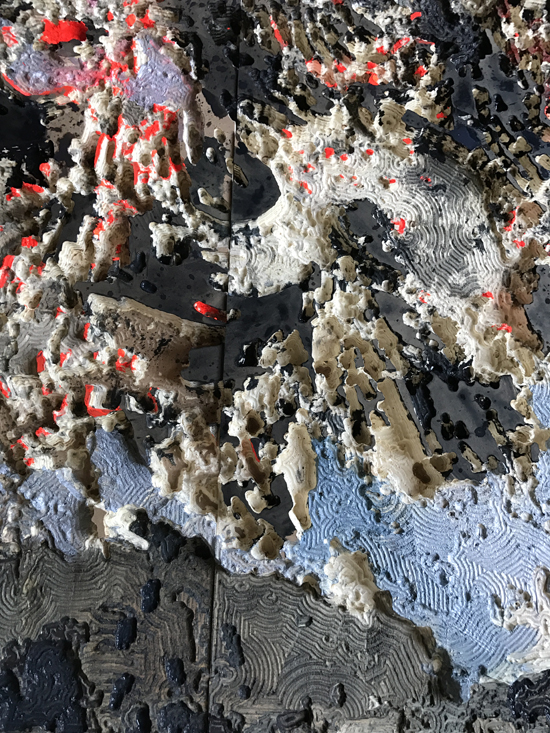
Territories of Complexities. Photos courtesy of the artist 2017
As Guillaume watched his French father’s health drift in and out from afar, for the next seven months, he became an artist. He fought by creating his topographical worlds with memories of the bourgeois accents of his native Marseilles echoing in his head.
Guillaume reluctantly told me that at age seven physical abuse by his father was rationalized by telling him it was because of the “improper ” way he spoke for a boy from Marseilles. He thus descended from speech to stuttering and then to silence, as the whole topic of language became an enemy. Then at age 11 or 12, as suddenly as his speech had been beaten out of him, he fought his way back from 5 years of complete silence with sheer willpower, and learned to talk again, just as he became a self-taught fine artist only seven years ago.
Determined as he is, he does not like the headstrong way the builders of New York City clear empty lots for their architectural sites for new buildings. When they cart away the rubble, sweep away the refuse, remove the layers of detritus and dust and the urban patina, it breaks his heart. So perhaps he uses paintings to savor the currents of necessarily unpleasant emotion, unleashing and then covering them up again.
Under the tortured surface of silvers and blues punctuated by tiny reds, yellows or light greens, flows of metallic tape and pigment emerge like flows of electricity in his work, like the movement of electrically charged particles traveling in feathery shapes or colliding like shiny geysers or in matte areas hiding in shiny black.
Where my perception was once of cleverly concealed dispassionate, phlegmatic gestures, now that I’ve heard his story, there are patterns suggestive of vulnerably turbulent water or air in motion. Not smooth or polished surfaces but pockmarked, irregular geomorphology. Uneven, chapped, rugged and wrinkled membranes of trapped language.
I ask him again what artists he likes. He finally mentions Gerhard Richter and Anselm Kiefer. While Kiefer’s works are characterized by an unrepentant willingness to face his culture’s dark past, Guillaume confronts his own past, more similar to the media-shy Richter, an artist who does not want to talk about his work. Paturel’s art is speech that says something that part of him does not seem to want explained.
“My pieces are cities, territories, urban landscapes either deserted or under construction,” he says. “My city of choice is geometry and chaos, order and disorder, verticality and stratification.”
So let us return to the 3 dimensional horizontal piece in the middle of the room. He fabricated it with the help of some architectural colleagues from one of the paintings in the show that they turned into a digital photo and then into software that extrapolates information into 3D to create “tool paths” which tell a machine how to carve in 3 directions, at 5 different pivot points, ultimately directing a “CNC router” to carve away designated areas of the 4” thick slab of wood that stretches out as wide as the paintings on the wall do—again, 5 or 6 feet rectangles. Form burrowed away in concentric irregular rings around elevated surfaces look like tiny islands in vast oceans. To these surfaces and large areas of wood where the color in the original painting was converted to raised land masses, the artist added new layers of color, different from its topographical doppelganger, hanging on the wall behind it.
While the technology and the technicians did a spectacular job of recreating in three dimensions, the original turbulent layers of paint and texture, subtle and not-so-subtle, complete with tape interruptions and handmade scrapes and scratches, the painting that it was derived from takes its orders from a kind of plan that robotic arms and digital code can imitate and simulate and even expand in untold new dimensions, but never understand. Despite continued clean, tidy attempts to the contrary by the contemporaries of Guillaume Paturel, art is capable of unearthing suppressed language that whispers, sometimes desperately, sometimes mysteriously, but if we listen, complex territory is revealed.
Guillaume Paturel was born in Marseille, France in 1970. he earned degrees in art and architecture from L’école des Beaux Arts in Marseille and Ecole Nationale Supérieure d’Architecture de Paris la Villette. He has produced architectural renderings for some of the world’s top architects, including Sou Fujimoto, Didier Faustino, Mos Architects, Maurizio Pezo, and Sofia von Ellrichshausen. Other highlights include renderings for the new One World Trade Center Tower and Memorial and K.A.Care’s sustainable city in Saudi Arabia. Paturel is also an accomplished filmmaker whose works have been shown in film festivals in france and switzerland. Paturel has had solo exhibitions of his paintings in New York City at Fragmental Museum (2012), One Art Space (2013), and A+E Gallery (2015).https://guillaume-paturel.squarespace.com/
Mark Bloch (American, born 1956, www.wikipedia.org/wiki/Mark_Bloch) is recognized as being one of a handful of early converts from mail art to online communities.In 1989, Bloch began his experimental foray into the digital space when he founded Panscan, part of the Echo NYC text-based teleconferencing system, the first online art discussion group in New York City. Panscan lasted from 1990 to 1995. Following the death of Ray Johnson in 1995, Bloch left Echo and began a twenty-year research project on Communication art and Johnson, and wrote several texts on him that were among the earliest to appear online and elsewhere. Bloch and writer/editor Elizabeth Zuba brought together an exploration of Ray Johnson’s innovative interpretations of ‘the book’” at the Printed Matter New York Art Book Fair in 2014 at MoMA PS1. Bloch has since acted as a resourcefor a new generation of Johnson and Fluxus followers on fact-finding missions.
WhiteBox, located in NYC, is a non-profit art space that serves as a platform for contemporary artists to develop and showcase new site-specific work, and is a laboratory for unique commissions, exhibitions, special events, salon series, and arts education programs. WhiteBox was founded in 1998. http://whiteboxnyc.org/
Meet Kunai NYC
New Meanings In Design
July 22, 2021
Kunai NYC by Kunai NYC
by correspondent Clara Joy
Andrew Hubert (21) has been a founder and organizer of New York City design communities since the age of 16. Beginning his introduction to design through New York City urban exploration, his relationship to space has had ground level and interventionist attitudes since he can remember. When he found his mothers old sewing machine at 15, he began creating garment-pieces that related to space and archetype. Immediately following his enrollment at FIT, his relationship to design became community driven, and culturally iconic in New York City. The creation of Kunai NYC in 2017, a design project based out of New York City, has received massive success, with a dedicated following of over 7,000 people. Kunai NYC has been engaging with the public for 5 years, creating works such as AF1 Sandals, in which he carved out the leather of the iconic Nike AF1 Sneaker, leaving the bones, now, a sandal. Intervening, adding and changing the culture surrounding the famous shoe, the AF1 Sandal became an iconic commentary on market culture, and design, receiving a virality of over 30,000 shares.
Andrew Hubert’s first design project, Kunai: Iterations focuses on a young man wearing film rolls as bondage pants, with fishnet string, tape, and a thread choker on his neck in an alleyway. The piece shows a modern day re-contextualization of old cultural signifiers, replaced with untouched archetypes. In 2018, USPS Forms and Masking Tape shows a young man displaying himself with postage stickers all over his body in an alleyway. Boiler Room Preview, a 2018 piece of a young man in grip gloves, a muscle tee and velcro pants, stands in a boiler room, ready to fight, displaying Kunai on his side waist, held by a mesh belt. The archetype’s displayed in these pieces are radically opposed to the conformist ideas of clothing’s traditional and historical symbolisms. They challenge fashion archetypes through a non-categorized and un-naturalized approach. The collection Winter 2019 shot in a vacant warehouse basement, shows young men displaying themselves in ballsy structured clothing. Jackets that open into 5 wings, pockets filled with money in laundry rooms, money in washing machines, silver ponchos, one man ironing white PVC jackets in corners of dark spaces. In Prism-Shell Jacket, a jacket is displayed in a room, with clear pockets of medicine, gas station snacks, action figures, and an asthma inhaler. In 2019, beginning his work as an organizer, Andrew Hubert founded and organized 310 Canal Street, an artist-run space. The space included design works by New York City’s design community, video artists, DJ’s, rappers, and archive clothing sellers, funded by Ryan Foss for On Canal. In 2019, Andrew Hubert released the infamous Tendril Shirt, a deconstructed corporate button down, made with tendrils falling off of each side of the shirt. The shirt worked with architecture to display its disruptive symbolism. Placing the Tendril Shirt on a pool table, a forest’s floor, on a floating piece of styrofoam floating in a river, in an alley beneath a fallen air conditioner, in a fabric store, on a teenage girl in a haunted storage space, on a bed of snow, on a destroyed cardboard box, thrown at a wall, in a college apartment. In 2020, Andrew Hubert began releasing studio works from a shared studio with Kevin Johnn in New York City.
During this time, Andrew Hubert documented young emerging designers and cultural icons wearing his pieces. To embody a rejection of the perfect background, he insisted on showing the behind the scenes of his studio by capturing the floor and outside borders of selected images, and breaking the rules of photography. Andrew Hubert released Chaos Leggings in 2020, a piece where he runs through the streets of the Garment District of Manhattan in knit-mesh threaded leggings, filming himself at ground level with an extruding tripod. In 2021, Andrew Hubert worked with OneGo NYC to exhibit a show-room of Kunai clothing, alongside Jean Paul Gaultier and Vivienne Westwood, as well as other canonized designers. Since April 2021, he has been based in the Silver Valley of Idaho, focusing on a site-specific series of works dealing with the vying powers of agrophillic commerce and the tourism-centric state, exploring how the local communities are affected by the growing schism of these forces. Bootleg Adidas documents the locals of the Silver Valley wearing Kunai clothing while feeding chickens, running through forests, Kunai tree choppers, a poncho in a snowy forest, Kunai hats burning in fire pits and hiding in mossy caves. Most recently, he was an invited participant and organizer by artist Alison Knowles for her feature length video reading of The House of Dust presented in Wiesbaden, Germany in 2021 at the construction site of the artist’s corresponding 3D printed building.
Andrew Hubert (21) (http://www.instagram.com/kunai.nyc): began organizing New York City design events at the age of 16 and founded Kunai NYC in 2017. He enrolled in Fashion Institute of Technology in 2018 having already shifted his public design practice to a massively successful community driven model. In 2017 As Kunai NYC, he launched projects that changed culture surrounding the shoe. His iconic AF1 Sandal received over 30,000 shares due to its commentary on market culture. In 2018, he challenged fashion archetypes through un-categorized, interventionist attitudes with USPS Forms and Masking Tape and Boiler Room Preview. His collection, Winter 2019, shot in a vacant warehouse, shows young men displaying themselves in ballsy structured clothing — jackets that open into 5 wings — pockets filled with money. Or, an open hermeneutic from an installed jacket with clear pockets full of medicine, gas station snacks, action figures and an asthma inhaler. He redoubled his efforts as an organizer in 2019 when he founded 310 Canal Street, an artist-run space for a network of counter-cultural designers. That year Kunai NYC designed Tendril Shirt, a dismantled corporate button down shirt, remade with tendrils falling from each side. In 2020, he opened a shared studio with Kevin Johnn in NYC, realizing over 100 works. He also released Chaos Leggings, documenting himself intervening the Manhattan Garment District in knit-mesh threaded leggings. By invitation from OneGo NYC, in 2021 he showed Kunai NYC clothing alongside Jean Paul Gaultier, Vivienne Westwood and other historic designers. Since April 2021, he’s been traveling to the Silver Valley of Idaho for site-specific work about agrophillic commerce and the tourism-centric state, exploring their impact on local communities. Bootleg Adidas documents Silver Valley locals feeding chickens and running through forests in Kunai NYC clothing. Most recently, he participated in an historic feature length video-reading of The House of Dust by founding Fluxus artist Alison Knowles. Filmed at Emily Harvey Foundation in NYC, it was shown in Wiesbaden, Germany in parallel to the construction of her 3D printed building. More at http://www.instagram.com/kunai.nyc
Clara Joy (21) (http://www.instagram.com/clrajoy): based in NYC is a known downtown recording artist. She is first documented performing at Harvestworks in Soho at the age of 5, at age 9 performing at Radcliffe College and at age 12 performing in The Highline inaugural arts festival. Between ages 12 & 13, from an art-studio in a converted mill building, she launched a wildly successful online performance-photo project, SoftOceans, for which she also designed & fabricated hand made clothing-art — selling hundreds of pieces to an audience of over 21,000 people. At age 13, as a working photographer, she professionally documented the artist Alison Knowles for curator Hans Ulrich Obrist. By age 15, she was engaged as a correspondent to cover the Frieze Art Fair recreation of George Maciunus: Flux Labyrinth (1970/2015) and shortly after became director of the official Instagram channel for Alison Knowles. She began recording songs as Clara Joy in 2015, with 7 albums and 2 singles released to date, which have earned critical acclaim. Intervening band culture, she appears alone on stages, yet has incited multi-artist concerts in the streets. In 2019 Clara Joy was featured in Humans of New York. During 2020, Part of Something (2021), the first film about Clara Joy was made by Sophia Johnson and debuted in 2021. Most recently, Clara Joy is documented performing with artist Alison Knowles in her feature length video reading of The House of Dust presented in Wiesbaden, Germany in 2021 at the construction site of the artist’s corresponding 3D printed building. Clara Joy was a 2021 invited performer for the Brooklyn Rail’s event dedicated to Nam June Paik and inaugurated the sold out reopening concert of Elsewhere in East Williamsburg, Brooklyn. More at http://www.instagram.com/clrajoy